
Market Volatility: Why Staying the Course Matters

- ✓ Market volatility is normal, even in positive years. Historically, the S&P 500 has experienced meaningful declines during the year while still frequently finishing in positive territory.
- ✓ AI is the new worry, but worry isn't new. Questions about valuations, spending, and technological disruption echo concerns investors have faced during past periods of innovation.
- ✓ Bull markets have historically been longer and stronger than bear markets. While downturns can be painful, periods of market growth have generally lasted longer and delivered greater gains.
- ✓ A disciplined investment strategy matters more than predicting the next market move. Diversification, periodic rebalancing, and maintaining an appropriate allocation can help investors navigate volatility without allowing headlines to dictate their decisions.
- ✓ Sustainable investing offers another reason to stay focused on the long term. By considering material ESG risks and aligning investments with personal values, investors can pursue their financial goals while supporting the kind of future they want to help create.
When Market Volatility Makes Headlines
There's rarely a shortage of reasons to worry about the stock market, and lately, investors have had plenty to think about. After years of excitement surrounding artificial intelligence, questions are growing about whether the enormous investments being made in AI will ultimately pay off. Recent swings in technology stocks, high-profile outages, the midterm elections, and ongoing geopolitical tensions have only added to the uncertainty, leaving many investors wondering: Is this time different?
In some ways it is. AI is reshaping entire industries, and the challenges we face today are unique to this moment, but uncertainty itself is nothing new. Investors have lived through recessions, wars, financial crises, and technological revolutions, many of which felt unprecedented at the time, and markets recovered and kept growing anyway.
That doesn't mean every downturn will be short, or that the risks should be brushed aside, it just means that short-term swings are only one chapter in a much bigger story.
The following three charts offer some perspective on what history can teach us about navigating today's uncertainty.
1. Downturns Are Not the Same as Down Years
When markets start falling, it's easy to assume that a rough stretch means a rough year, but history tells a more nuanced story. In almost every year, even the great ones, the market has had a scare along the way, and most of those years still ended higher. Take 2020: the pandemic sent stocks sharply lower, yet by December they had recovered and the year finished in positive territory.
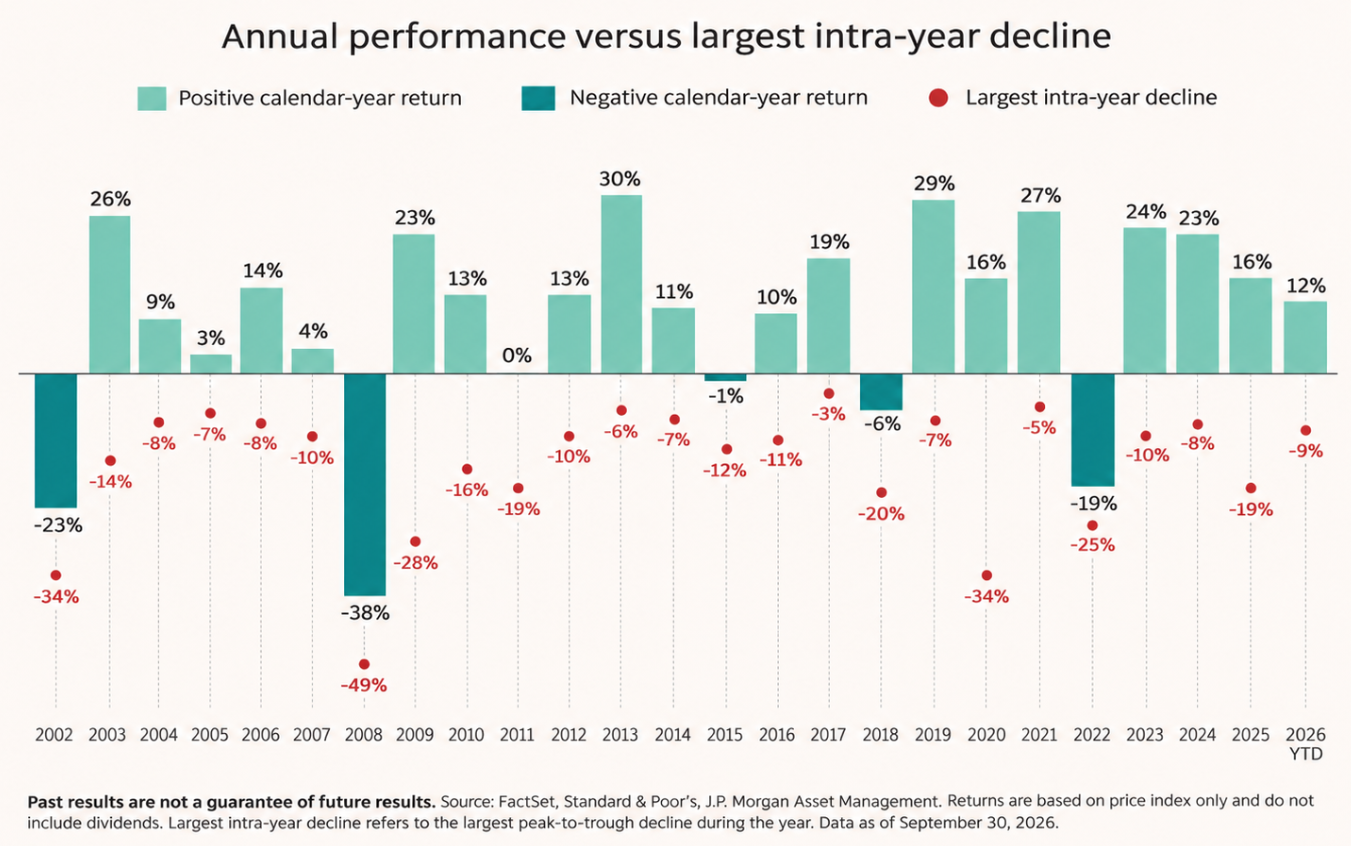
This is why reacting to short-term market declines can be so costly. Selling when markets fall may offer some immediate peace of mind, but it also raises the question of when to get back in. And because some of the market's strongest days have historically occurred during periods of heightened uncertainty, waiting for things to settle down can mean missing out on a meaningful part of the recovery.
Rather than trying to avoid every downturn, the goal is to have a strategy that can weather the inevitable ups and downs without losing sight of what you're investing toward.
2. Today's Headlines Are Part of a Much Longer Story
Over the past several decades, investors have navigated everything from the crash of 1987 and the dot-com bubble to the 2008 financial crisis and the COVID-19 pandemic. Each brought its own uncertainty, and at the time, no one could say for sure how things would unfold.
Yet alongside these challenges, the world has continued to evolve. New technologies have emerged, industries have transformed, and businesses have found ways to adapt. The rise of the internet in the 1990s is just one example of how a period of profound change and uncertainty ultimately helped reshape the global economy.
It's a reminder that uncertainty and progress often go hand in hand, and that today's headlines are just one chapter in a much longer story.
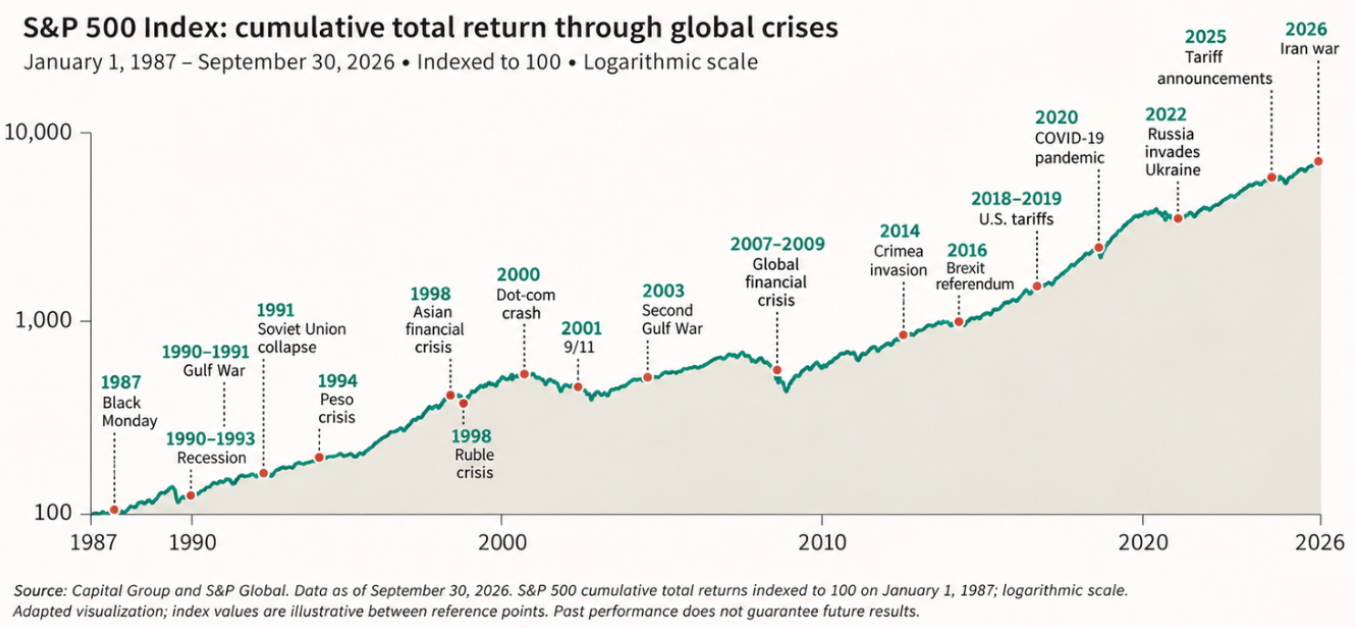
Looking at the bigger picture, it's remarkable how many events that once seemed capable of derailing the global economy are now just points along the market's long-term path.
That's not to minimize the very real challenges investors have faced along the way, or the uncertainty we're experiencing today. But it does offer a useful reminder that economic growth and innovation have continued through periods of extraordinary change, often in ways that were difficult to imagine at the time.
3. The Rhythm of Long-Term Progress
Another reassuring lesson from market history is that periods of growth have generally lasted much longer than periods of decline. Bear markets, typically defined as drops of 20% or more, can be unsettling, especially when the economic outlook is uncertain. But historically, bull markets have lasted an average of 67 months, delivering cumulative gains of 265%, while bear markets have averaged just 12 months, with declines of 33%.
It's a reminder that while market downturns are inevitable, they've historically been outweighed by longer periods of growth.
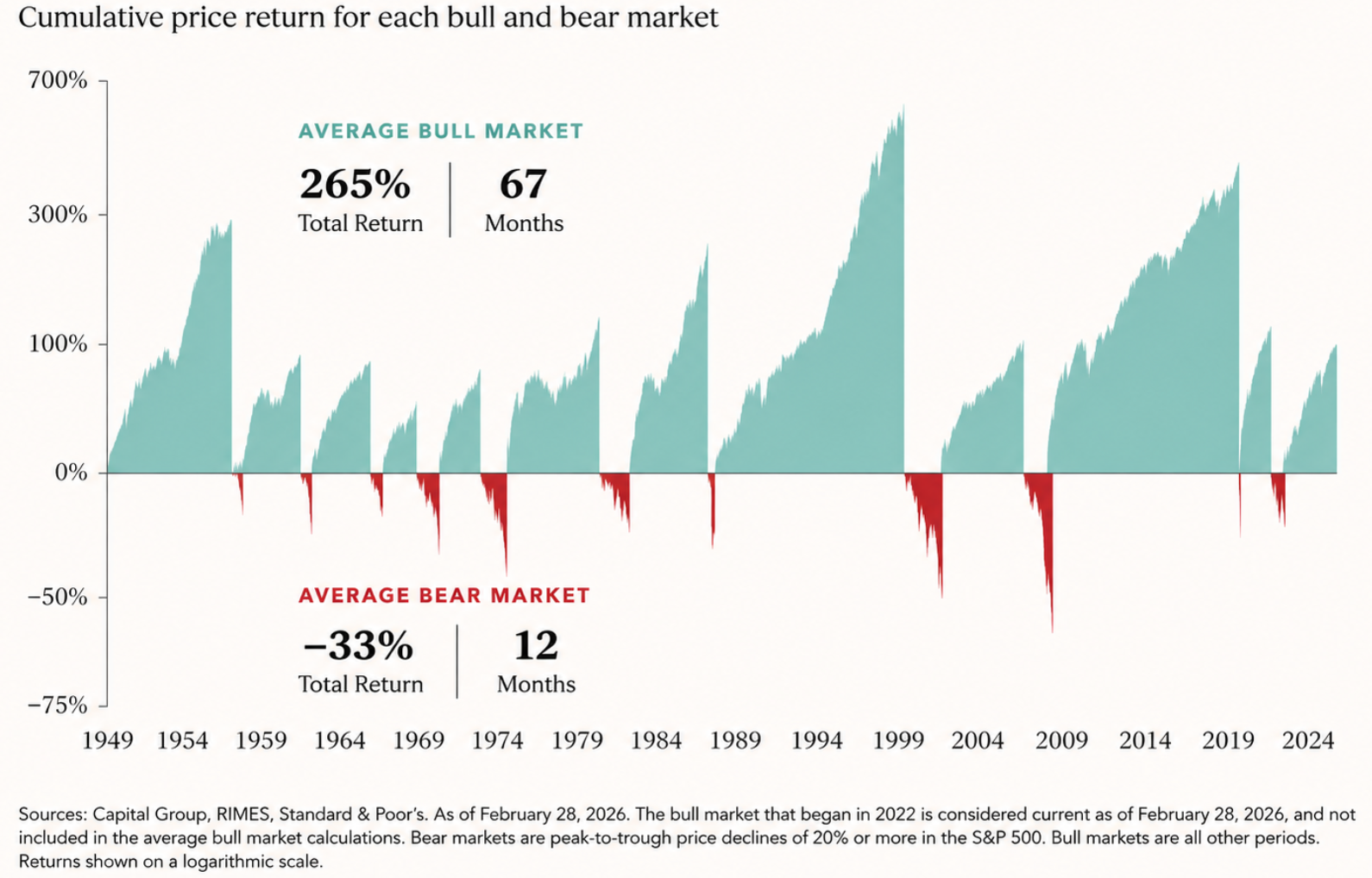
Of course, history can't tell us when the next downturn will happen or how long it might last, but it does remind us that while market declines often grab the headlines, the longer periods of growth have historically played a much bigger role in building wealth over time.
Keeping the Bigger Picture in Focus
Periods of market uncertainty remind us that successful investing is about more than navigating short-term price movements. It's also about understanding the businesses behind our investments and how well they're positioned to adapt to a changing world.
That's where an environmental, social, and governance (ESG) perspective can add another layer of insight. Beyond traditional financial metrics, ESG considerations help us evaluate how companies manage risk, govern themselves, respond to emerging challenges, and prepare for the future. Whether it's the rapid development of artificial intelligence, environmental challenges, or evolving economic conditions, these factors can have meaningful implications for a company's long-term resilience.
But there's another side to sustainable investing that's just as important. When your investments reflect the issues you care about and the kind of world you hope to help create, there's a sense of purpose that goes beyond the numbers on a statement. Knowing that your money is aligned with your values, and that your voice as a shareholder can help encourage positive change, may make it a little easier to stay focused on the bigger picture when markets get rocky.
After all, investing for the long term isn't just about the financial future you're building. It's also about the world you want to help shape along the way.
What Does This Mean for Your Portfolio?
Experience matters, especially when it comes to your money. For more than 25 years, we've helped clients navigate recessions, market corrections, and no shortage of unsettling headlines. While every downturn brings its own challenges, our approach has remained much the same: building diversified portfolios designed to weather changing markets while keeping your long-term goals in focus.
Of course, we can't predict how long the current uncertainty will last or exactly when markets might turn around. What we do know is that markets tend to look ahead, often recovering before the economic outlook or headlines begin to improve. That's why we continue to monitor portfolios, take advantage of opportunities when they arise, and make thoughtful adjustments rather than trying to predict every market move.
Our advice, however, remains simple: stay focused on your long-term goals, take advantage of opportunities when they make sense, and don't let the daily financial news dictate your investment decisions. It's never easy in the moment, but maintaining perspective and discipline can make all the difference.
This article is for informational purposes only and does not constitute investment, legal, or tax advice. The S&P 500 Index is an unmanaged index that cannot be invested in directly. Index returns do not reflect investment management fees, transaction costs, or taxes. Past performance does not guarantee future results. All investments involve risk, including the possible loss of principal. Historical market statistics are provided for educational purposes and do not represent the performance of Blue Marble portfolios. Diversification and rebalancing do not guarantee a profit or protect against loss.
Disclosure: Blue Marble Investments is an SEC registered investment adviser. SEC registration does not constitute an endorsement by the SEC nor does it indicate that Blue Marble has attained a particular level of skill or ability. This material is for informational purposes only and is not intended to serve as personalized tax, legal, or investment advice. Please consult with your tax and/or legal professional regarding your specific situation when determining if any mentioned strategies are right for you.*