
What Is Values-Aligned Investing? Our Approach at Blue Marble

- ✓ It is not always obvious what you actually own. Most diversified funds hold hundreds of companies, which can make it difficult to know whether your investments truly reflect the issues and values that matter to you.
- ✓ At Blue Marble, ESG is not a label we add after the fact. Every fund we use in our ESG portfolios must be ESG by design, with environmental, social, and governance standards built directly into the fund's mandate and prospectus.
- ✓ Our low-carbon portfolios go beyond simply reducing carbon exposure. They apply the same broader ESG standards as our core portfolios while also screening out companies involved in the production, manufacturing, or distribution of coal, oil, and natural gas.
- ✓ Your portfolio can still feel personal even when the underlying funds follow established mandates. In accounts that include individual stocks, we can use that portion of the portfolio to reflect your priorities more closely.
- ✓ You do not have to guess how aligned your current investments are. We offer complimentary ESG comparison reports that can show where your existing portfolio aligns with your values, where it may not, and how it compares with a Blue Marble portfolio.
- ✓ Investing according to your values does not mean you have to give up competitive long-term performance. A well-constructed ESG portfolio can still be diversified, cost-conscious, and designed around the same financial goals as a traditional portfolio.
What Does Values-Aligned Investing Actually Mean?
Most of us already think about our values when deciding where to spend our money.
We may choose one company over another because of how it treats its employees, avoid certain products because of their environmental impact, or intentionally support businesses whose practices we believe in.
But when it comes to investing, that connection can be much harder to see.
A mutual fund or ETF may own hundreds of companies, and most investors understandably are not going through every holding one by one to figure out exactly what they own. That can create a real disconnect between the things someone cares about and the companies their savings are ultimately supporting.
In fact, many of the clients who come to us have already tried to have these conversations with another advisor. They may have said that climate change matters to them, that they do not want to own weapons or tobacco companies, or that they want to understand the social impact of their investments, only to feel like those concerns never quite made it into the portfolio.
That is something we hear often.
For us, ESG is not a separate language we have to translate. It is our first language. These are conversations we have every day, and they are part of how we have always approached investing.
Values-aligned investing is simply a way of closing the gap between what you care about and what you own.
At Blue Marble, our goal is not to tell clients what their values should be. It is to understand what matters to them and then build a financially sound portfolio that reflects those priorities as much as reasonably possible.
We believe those two goals, investing responsibly and investing well, can absolutely coexist.
How Values-Aligned Investing Works at Blue Marble
We generally approach values-aligned investing in three ways.
Investing intentionally. We look for companies and funds that meet both our financial standards and our environmental, social, and governance criteria. Values alignment matters, but so do fundamentals, diversification, risk, cost, and the role an investment plays within the broader portfolio.
Screening out certain industries and business practices. There are companies and activities we do not believe belong in our standard ESG portfolios. Screening allows us to reduce exposure to businesses that conflict with the environmental and social standards built into our investment process.
Engaging as shareholders. Owning a company also gives investors a voice. Through proxy voting, shareholder engagement, and collaboration with other responsible investors, shareholders can push companies toward better disclosure, stronger governance, and more responsible business practices.
That last piece is important because sustainable investing is not only about deciding what not to own.
Selling a stock does not, by itself, change how a company operates. In many cases, remaining an engaged shareholder and using that position to advocate for improvement can be an important part of the process.
For us, these approaches work together.
Our Screening Standards
One of the most important distinctions in how we build portfolios is that we are not simply taking a traditional fund and calling it ESG because it happens to score well on a third-party rating.
Every fund we incorporate into our ESG portfolios must have an ESG mandate and be ESG by design.
In practical terms, that means the fund itself is built around environmental, social, and governance considerations, with those standards incorporated directly into its investment process and prospectus. The screening is part of how the fund is designed to invest, not something we are layering on after the fact.
We think that distinction matters.
One of the most important distinctions in how we build portfolios is that we are not simply taking a traditional fund and calling it ESG because it happens to score well on a third-party rating.
Every fund we incorporate into our ESG portfolios must have an ESG mandate and be ESG by design.
In practical terms, that means the fund itself is built around environmental, social, and governance considerations, with those standards incorporated directly into its investment process and prospectus. The screening is part of how the fund is designed to invest, not something we are layering on after the fact.
We think that distinction matters.
Core ESG Portfolio
Our core ESG portfolios apply a broad range of environmental, social, and governance screens across the funds we select.
Tobacco and civilian firearms are two examples that tend to be easy to explain, but they are only a small piece of a much larger screening process.
Depending on the underlying fund, screens may address areas such as controversial weapons, environmental practices, human rights, labor standards, corporate governance, and other business activities that do not meet the fund's established ESG criteria.
The specific methodology will vary somewhat from one fund manager to another, which is why part of our due diligence is understanding not just whether a fund markets itself as sustainable, but what its actual mandate requires it to do.
We look under the hood.
We want to understand what is being screened, how companies are evaluated, what thresholds are being used, and whether the investment manager's actual process matches what we expect from an ESG strategy.
Low-Carbon Portfolio
Our low-carbon portfolios start with the same ESG foundation.
The same broader environmental, social, and governance standards still apply, but we add a much stricter screen when it comes to fossil fuels.
For these portfolios, that means screening out companies involved in the manufacturing, distribution, or production of coal, oil, or natural gas.
The idea is not simply to own a portfolio that has slightly lower carbon emissions than the broader market. For clients who feel strongly about fossil fuel exposure, we want the distinction to be meaningful.
That makes our low-carbon approach a better fit for clients who want the broader ESG framework but also want a more stringent line drawn around fossil fuels.
Going One Step Further With Individual Stocks
The ESG funds themselves follow their own established mandates, which means we cannot simply add custom screens to an underlying fund based on an individual client's preferences.
Where we do have more flexibility is within the individual stock portion of a client's portfolio.
Some clients care deeply about additional issues, whether that means nuclear energy, weapons, human rights, labor practices, animal welfare, or something else entirely. We can talk through those priorities and be thoughtful about the individual companies we include so that this portion of the portfolio reflects those values more closely.
That gives us another layer of personalization without changing the underlying investment mandate of the ESG funds themselves.
For us, that balance is important. We want the portfolio to feel personal, but it still needs to remain diversified, financially sound, and aligned with the client's broader investment strategy.
Not Sure How Your Current Portfolio Measures Up?
A lot of people come to us knowing they want to invest more sustainably, but they have no idea what is actually inside their current portfolio.
That is completely understandable.
Even when an investment has "ESG," "sustainable," or "responsible" in the name, it can be difficult to tell what those terms actually mean, how strict the underlying screens are, or whether the companies inside the portfolio line up with the issues you care about.
That is why we offer complimentary ESG portfolio comparison reports for prospective clients using YourStake, a New York-based ESG and values-alignment research platform.
YourStake allows us to look more closely at the investments you already own and compare them with a values-aligned portfolio across a range of environmental and social issues.
The goal is not to give your portfolio a generic ESG score.
It is to make the conversation more concrete.
We can look at where your current investments are already aligned with your values, where there may be exposures you were not aware of, and how a Blue Marble portfolio might compare.
For many people, seeing the two portfolios side by side is much more useful than simply being told that one investment is "more sustainable" than another.
Curious how your current portfolio compares?
Send us a recent investment statement and we can prepare a complimentary ESG comparison report so you can see how your existing investments line up with the issues that matter most to you.
Does Investing According to Your Values Mean Giving Up Returns?
This is probably the question we hear most often, and understandably so.
Your portfolio still has a job to do. It may need to fund retirement, provide income, support your family, preserve wealth, or meet goals decades into the future. Values alignment should not mean ignoring those responsibilities.
The good news is that incorporating ESG criteria or applying reasonable investment screens does not inherently require giving up competitive long-term returns.
Broad ESG indexes and traditional market indexes have historically moved fairly closely over long periods, although there will always be periods when one performs better than the other. That is normal. Any time two portfolios own different investments, their performance will differ.
What matters much more, in our view, is how the overall portfolio is constructed.
A values-aligned portfolio should still be diversified. It should still be appropriate for the client's risk tolerance and time horizon. Costs should still be reasonable. Taxes should still be considered. Investment decisions should still be made with the client's long-term financial goals in mind.
In other words, the standards do not change just because values are part of the conversation.
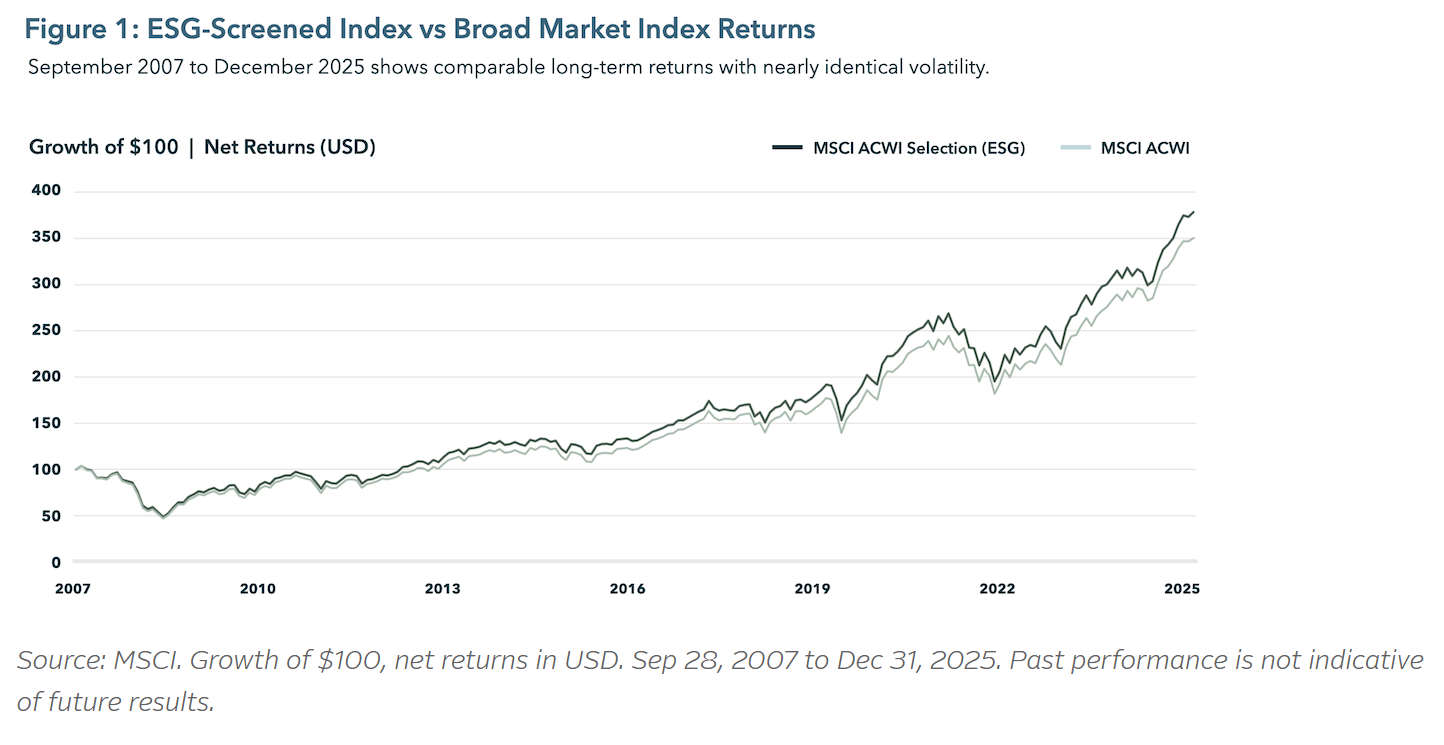
Over this period, the ESG-screened index and the broader market delivered very similar long-term returns with nearly identical volatility. While there will always be shorter periods where one outperforms the other, the long-term data shows that incorporating ESG screens does not necessarily mean giving up performance or taking on additional risk.
That is really the point. You should not have to choose between investing in a way that reflects your values and working toward your financial goals. A thoughtfully constructed portfolio can do both.
FAQs
-
ESG stands for environmental, social, and governance factors. These are criteria that can be used to evaluate how a company operates, manages risks, treats stakeholders, and approaches issues such as climate change or corporate governance.
Values-aligned investing is broader. It starts with the investor and asks: What matters to you, and how can we reasonably reflect that in your portfolio?
ESG research is one of the tools we use to answer that question.
-
Not necessarily.
Applying investment screens will change what a portfolio owns, which means its performance will not be identical to an unscreened benchmark. Some periods will favor one approach over another.
Our goal is not to promise that values-aligned investing will outperform. It is to construct a diversified portfolio that remains appropriate for your financial goals while incorporating the issues that matter to you.
As with any investment strategy, there are risks, and past performance cannot guarantee future results.
-
The underlying ESG funds follow their own established mandates, so we cannot add custom screens directly to those funds.
However, in portfolios that include an individual stock sleeve, we can be more intentional about the companies we select and use that portion of the account to better reflect the issues that matter most to you.
That gives us room to personalize the portfolio while still preserving the broader ESG framework and diversification of the strategy.
What Does This Look Like for You?
There is no single definition of a perfect values-aligned portfolio.
For one client, avoiding fossil fuels may be the priority. Someone else may care most about weapons, labor practices, human rights, or how companies treat their employees and communities. Another client may simply want to know that ESG considerations are being incorporated into the investment process without adding additional restrictions.
Our job is to understand what matters to you, figure out what is practical within the portfolio, and make sure those choices continue to support the larger financial plan.
A lot of our clients come to us because they have spent years feeling like this part of the conversation was missing. They knew what they cared about, but they were never quite sure whether those values were actually reflected in their investments.
We want to make that connection clearer.
If you are interested in seeing what a values-aligned portfolio could look like for you, we would be happy to talk through it.
This article is for informational purposes only and does not constitute investment, legal, or tax advice. Values-aligned and ESG investing strategies may not be appropriate for every investor, may limit the types of investments available in a portfolio, and may result in performance that differs from a benchmark that does not apply the same screens. Past performance is not indicative of future results. All investing involves risk, including the possible loss of principal. Please consult with a Blue Marble advisor regarding your individual circumstances before making investment decisions.
Disclosure: Blue Marble Investments is an SEC registered investment adviser. SEC registration does not constitute an endorsement by the SEC nor does it indicate that Blue Marble has attained a particular level of skill or ability. This material is for informational purposes only and is not intended to serve as personalized tax, legal, or investment advice. Please consult with your tax and/or legal professional regarding your specific situation when determining if any mentioned strategies are right for you.*